
Opinion|Videos|November 20, 2026 (Updated: November 20, 2026)
ILD Prevalence and Risk Factors Across Autoimmune Rheumatic Diseases
Fact checked by: Vivien Hsu, MD, Ara Dikranian, MD
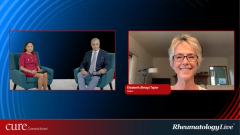
ILD prevalence varies widely across autoimmune diseases, and much depends on how carefully clinicians look. The panel reviews the data, the clinical clues, and the antibodies that signal elevated risk.
Advertisement
Episodes in this series
"ILD Prevalence and Risk Factors Across Autoimmune Rheumatic Diseases" takes up the question of how common ILD really is across the autoimmune rheumatic diseases.
Dr. Dikranian admits that no one knows the true prevalence, because the data are limited. He separates ILD in general from the smaller share of patients who develop progressive pulmonary fibrosis. Citing a large retrospective analysis covering millions of patients, he places ILD in a quarter to half of people with rheumatoid arthritis. About a fifth of those patients show progressive features. The figure approaches 75% in systemic sclerosis, while Sjögren's disease and mixed connective tissue disease fall between 25% and 75%. In his view, the main driver of these numbers is how well clinicians screen.
Dr. Hsu offers a different frame. In a room of 100 patients with autoimmune ILD, about half would have scleroderma and a quarter rheumatoid arthritis. The remaining quarter would include Sjögren's syndrome, mixed connective tissue disease, and undifferentiated connective tissue disease.
On risk, Dr. Dikranian calls stratification an evolving science. In rheumatoid arthritis, seropositivity, male sex, and current or past smoking predict more ILD, and seropositivity also raises risk in anti-synthetase syndrome. He screens newly diagnosed systemic sclerosis and anti-synthetase patients regardless of symptoms, but often reserves screening in rheumatoid arthritis for higher-risk or symptomatic patients.
Dr. Hsu starts with a careful history for muscle disease and an exam for rashes or skin thickening. She then turns to antibodies, noting that 70% of Scl-70-positive patients and 20% of anticentromere-positive patients can develop ILD. Seronegative Sjögren's patients with symptoms may need a lip biopsy to confirm the diagnosis. Dr. Dikranian adds that pulmonologists increasingly refer patients with interstitial pneumonia with autoimmune features. Dr. Hsu notes that these patients may have a high-titer ANA and few physical findings, yet still need treatment.
Up next, in "ILD Screening in Autoimmune Disease: HRCT, PFTs, and a Patient's Path," Dr. Dikranian walks through the right screening tests and how often to repeat them, and Betsy Taylor describes the long road to her own diagnosis.
Advertisement
Related to this article

In the phase 4 STAR trial, guselkumab improved BASDAI and MRI sacroiliac joint inflammation vs placebo at week 24 in axial psoriatic arthritis.

Twelve-month REDUCE-2 data on deeper serum urate targets, renal adverse events and the flare and tophi readouts still to come.

REDUCE-2 investigator Puja Khanna on gaps in oral urate-lowering therapy and why a selective URAT1 inhibitor was tested.

Secukinumab 150 mg doubled week-52 sustained remission vs placebo in REPLENISH, making it the first anti-IL-17 biologic approved for PMR.

Afimetoran achieved SRI-4 response rates of 64.1% to 67.8% vs 34.4% with placebo in a phase 2 SLE trial.
The 200-mg dose improved ACR20 response vs placebo at week 16 in biologic-naïve patients, while the 400-mg dose added no benefit.
An international IgG4ward! Foundation panel issued 28 treatment statements for IgG4-related diseases, with consensus reached on 22.

In 33 patients with myositis-associated ILD from FIBRONEER-ILD, nerandomilast numerically slowed FVC decline and lowered progression risk.
Advertisement
Advertisement
Trending on Rheumatology Live
1
Pozdeutinurad Durability and Kidney Safety, With Puja Khanna, MD, MPH
2
Upadacitinib Tied to Durable RA Response, With Louis Bessette, MD, MSc
3
Guselkumab Improves Axial Symptoms, MRI Inflammation in Axial PsA
4
Pozdeutinurad Lowers Serum Urate in Gout Trial, With Puja Khanna, MD, MPH
5